


Type
Location
In the constellation Perseus
Distance
220 million light-years (67 megaparsecs)
Mass
17 billion times the mass of the Sun
Size
Diameter more than 11 times the diameter of the orbit of Neptune, the most distant planet in our solar system
Discovery Methods

NGC 1277

This ground-based image shows NGC 1277 surrounded by many other galaxies of the Perseus Cluster.

A ground-based view of NGC 1277. It is the small, flattened galaxy at center, just to the upper right of a large round galaxy.

This diagram shows the size of the NGC 1277 black hole, with the orbits of Neptune and Earth around the Sun at the same scale. The black hole is roughly 64 billion miles/102 billion km in diameter; light would need almost four days to traverse that distance, compared to a few minutes or hours for the orbits of the planets.
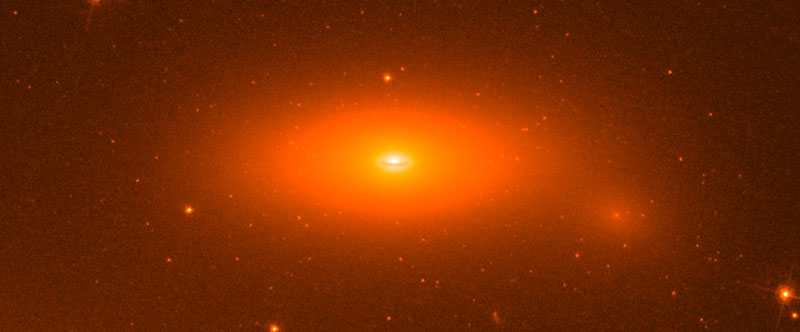
A Hubble Space Telescope view of NGC 1277, which clearly shows the galaxy’s lens shape.
This document was last modified: November 28, 2012.


Copyright ©2005-2013 University of Texas McDonald
Observatory | About this Site | Karl Gebhardt's Research | Enciclopedia de agujeros negros
Funding provided
by NASA and the National
Science Foundation