

NGC 1277

Type
Location
In the constellation Perseus
Distance
220 million light-years (67 megaparsecs)
Mass
17 billion times the mass of the Sun
Size
Diameter more than 11 times the diameter of the orbit of Neptune, the most distant planet in our solar system
Discovery Methods

NGC 1277
The supermassive black holes at the hearts of galaxies are sometimes described as dark monsters that feed on the stars and gas around them. Yet most of these black holes comprise only a tiny fraction of their host galaxies' total mass.
The black hole at the center of the galaxy NGC 1277, however, appears to make up about one-seventh of the galaxy's total mass -- the largest fraction for any supermassive mass hole yet measured. And it really is a dark monster: It's also the heaviest black hole yet measured, at 17 billion times the mass of the Sun (plus or minus 3 billion solar masses).
A team of astronomers studied the galaxy as part of the Hobby-Eberly Telescope Massive Galaxy Survey (MGS). The project is using the giant Hobby-Eberly Telescope at McDonald Observatory to target galaxies with suspected supermassive black holes.
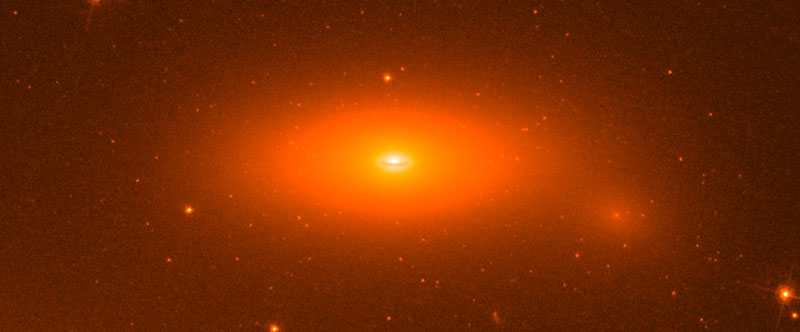
NGC 1277 is classified as a lenticular galaxy, so it is shaped like a lens, with a thicker central region that tapers away at the edges. It is only about one-tenth as large and massive as our home galaxy, the Milky Way, with a total mass (including invisible dark matter) of about 120 billion times the mass of the Sun.
The MGS team determined the black hole's mass by measuring the galaxy's total brightness and mass, the mass of its "halo" of dark matter, and the mass of its central regions, which contain the black hole. The team compared those observations to an image of the galaxy snapped by the Advanced Camera for Surveys aboard Hubble Space Telescope, which provided measurements of the galaxy's brightness at different distances from its center. Comparing these observations with different mathematical models yielded the black hole's likely mass.
The NGC 1277 black hole provides new information in the quest to understand the relationship between galaxies and their central black holes. Over a couple of decades, astronomers observed that there is a relationship between the mass of a galactic black hole and the mass of the "bulge" of stars around it. Accurate measurements of the masses of scores of black holes and their surrounding bulges has indicated that the "weight" of the black hole is generally 0.2 percent that of the bulge.
NGC 1277's black hole is far outside this range. However, the galaxy itself appears to have not a bulge of stars, but a "pseudobulge" -- a collection of stars that accumulated in a different way from true bulges. That difference may be the key to the black hole's greater mass, and suggests that the black holes at the center of pseudobulges have different formation mechanisms and histories than those at the centers of classical bulges, which are found in elliptical and spiral galaxies.
Most of the stars of NGC 1277 are at least eight billion years old (almost twice the age of the Sun). The team that studied the galaxy says the black hole must have been in place for at least that long because models of black-hole formation require either episodes of new star formation or the process that gives birth to a classical bulge to build such a massive black hole.
Survey
Did you find what you were looking for on this site? Take our site survey and let us know what you think.
This document was last modified: November 28, 2012.


Ground-Based Photo

Ground-Based Photo

Diagram
Space-Based Photo


No animations available for this black hole.